


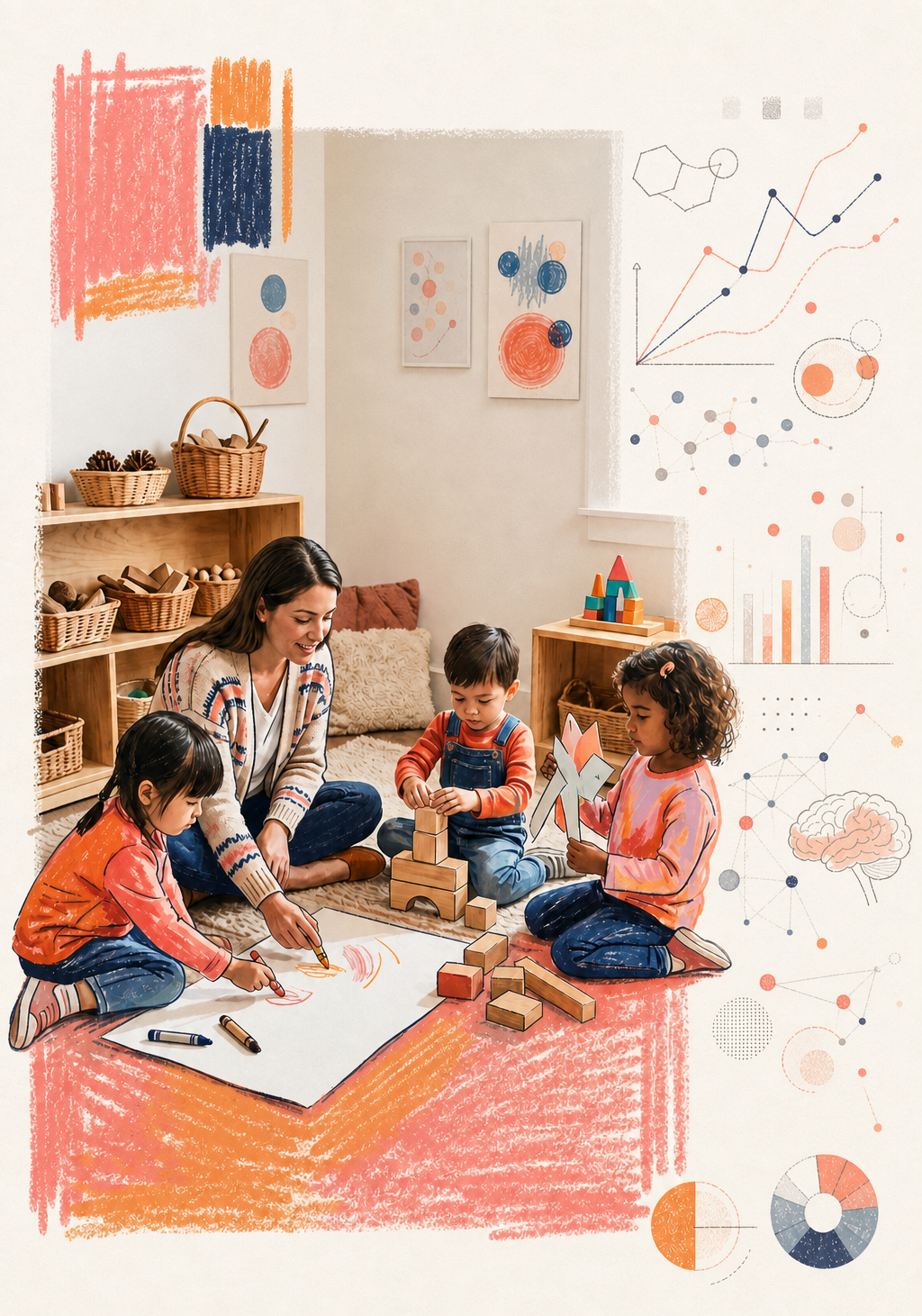
The impact of Blum has been examined in two independent university research studies.
A quantitative study was conducted through a collaboration between the University of Szeged and the French research organization Association Aloïs (Paris). The findings of the study were published in a peer-reviewed scientific journal.
A qualitative study was led by researchers from the Faculty of Education and Psychology at Eötvös Loránd University (ELTE PPK). The study has been completed, and a scientific publication presenting its findings is currently in preparation.
Quantitative study
A quantitative study conducted in 2021–2022 examined the impact of “Connection – Artistic Play Space” across three kindergarten groups. A scientific publication presenting the findings was published in 2024.
In institutions where educators had completed Blum training and worked according to this approach, statistically significant improvements in children’s cognitive development were observed. Using reliable, validated assessment tools, the study examined attention, vocabulary, working memory, and emotional regulation—key foundations of school readiness and a successful transition to school.
The findings confirm that the method does more than create meaningful experiences: it initiates genuine developmental progress.
Further details and research findings:
→ Effect of Blum pedagogy on onset Executive Functions – E-Eruditio
Qualitative study
A qualitative study published in 2024 examined how the Blum Method influences the inner professional world of early childhood educators, based on in-depth interviews and case studies. The participants reported rediscovering the meaning of play, deepening their sensitivity to the child’s world, and learning how to be truly present in their work with children.
The perspective of PARC – Play, Art, Relate, Connect (the “artistic play space of connection”) also transforms the way educators work. As playful and reflective presence becomes stronger, children in the group tend to become more balanced and more capable of self-regulation. According to educators’ reports, symptoms of anxiety and conflicts among children decrease significantly and in many cases disappear altogether.
Main Findings of the Qualitative Research
Participants rediscovered the meaning of play, their sensitivity to the child’s world,
and how to be truly present.
Self-Awareness and Reflection
Connection
Anxiety
Empathy and Trust
Changes in Children
Conflict Management
Dr. Bertrand Schoentgen
Managing Director of Aloïs
Dr. Asztrik Kovács
Counselling Psychologist, Assistant Professor at Eötvös Loránd University